
As winter settles into the Greater Philadelphia area, many homeowners turn to their fireplaces for warmth and comfort. But beyond ambiance, an important question comes up every year: Are fireplaces actually an efficient way to heat your home?
Understanding fireplace energy efficiency is key to knowing whether your fireplace helps reduce heating costs or unintentionally makes your home colder. Below, we’ll break down how fireplaces produce heat, when they work best as a supplemental heat source, and what homeowners can do to improve efficiency.
How Much Heat Does a Fireplace Actually Produce?
When homeowners ask how much heat a fireplace produces, the answer depends on the type of fireplace and how that heat is delivered into the room. Traditional wood-burning fireplaces do create heat, but not in a way that efficiently warms a home.
Open fireplaces mainly produce radiant heat, meaning you feel warmth directly in front of the fire. While this can feel comfortable, the heat does not circulate well. At the same time, much of the heat generated by the fire rises up the chimney and escapes outdoors.
This is why fireplace heat output can be misleading. Unlike furnaces or boilers that capture and distribute heat evenly, open fireplaces provide localized warmth with limited reach. Once airflow losses are factored in, the overall heating benefit is often minimal.
As a result, a traditional fireplace may feel warm up close, but it rarely provides efficient or consistent heat for the rest of the home.
Why Traditional Fireplaces Are Often Inefficient
Many homeowners are surprised to learn that open fireplaces can actually make their homes colder instead of warmer. This happens because a traditional fireplace is essentially an open hole in the house that disrupts normal airflow and pressure balance.
When a fire is burning, the chimney pulls smoke upward, but it also pulls large amounts of already-heated indoor air out of the home. To replace that lost air, cold air from outdoors is drawn in through gaps, cracks, and leaks throughout the house. Even when the fireplace is not in use, the chimney can continue acting like a vacuum if the damper is open or poorly sealed.
As a result, traditional fireplaces often create several efficiency problems, including:
- Warm indoor air being pulled up and out through the chimney
- Cold outdoor air entering the home through doors, windows, and other leaks
- Ongoing fireplace draft problems that allow heat loss even when no fire is burning
Together, these airflow issues reduce overall fireplace energy efficiency and force your primary heating system to work harder, often leading to higher heating costs during the winter.
When a Fireplace Works as a Supplemental Heat Source
Despite their limitations, fireplaces can still be useful when used correctly. Heating with a fireplace makes the most sense when it’s treated as a supplemental heat source, not a replacement for central heating.
Fireplaces work best when they are:
- Used to heat a single room or living space rather than the entire home
- Paired with proper airflow control and insulation
- Supplementing, not replacing, your main heating system
When expectations are realistic, fireplaces can add comfort without excessive energy loss.
Gas vs. Wood Fireplaces: Efficiency Differences Homeowners Should Understand
Not all fireplaces perform the same, and the differences in design have a major impact on efficiency and heat delivery. Traditional open hearths lose most of their heat up the chimney, while modern systems are built to capture heat and keep it inside the home.
For homeowners looking to improve efficiency, the following options offer very different levels of performance:
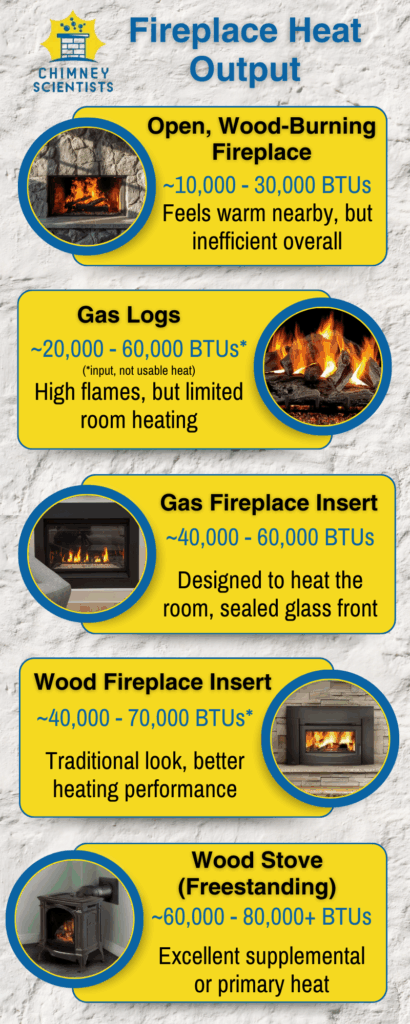
- A gas fireplace insert is sealed and engineered to push heat into the living space instead of allowing it to escape up the chimney, making it a significantly more efficient option than an open fireplace.
- Gas logs for fireplaces offer convenience and visual appeal, but because they are typically installed in open fireplaces, they provide limited heat and lower overall efficiency.
- An efficient wood fireplace insert improves heat retention by enclosing the firebox, allowing homeowners to enjoy the look and feel of a wood fire while producing more usable warmth.
- A wood stove for home heating delivers the highest heat output and is often capable of heating large areas, or even entire homes, when properly sized and installed.
Choosing the right system depends on how you plan to use your fireplace and how much supplemental heat you want to achieve.
How To Improve Fireplace Efficiency
If you already have a fireplace, improving its efficiency often comes down to controlling airflow and reducing unnecessary heat loss. Even small adjustments can prevent warm air from escaping up the chimney and help your fireplace contribute more effectively as a supplemental heat source.
Homeowners can improve fireplace performance by taking the following steps:
- Manage airflow by using the damper correctly
- Reduce drafts when the fireplace is not in use
- Upgrade to a sealed insert or stove designed for better heat retention
- Use the fireplace strategically during peak heating hours
These targeted improvements can make a noticeable difference in both comfort and energy use without requiring major renovations.
Signs Your Fireplace May Be Hurting, Not Helping, Your Heating Bills
In some situations, a fireplace can actually make a home less efficient instead of more comfortable. This usually happens when heat loss and airflow issues outweigh the warmth the fireplace provides.
Homeowners may notice the following signs that a fireplace is increasing heating costs rather than reducing them:
- Cold drafts near the fireplace when it’s off
- Rooms cooling rapidly after the fire goes out
- Uneven temperatures throughout the home
- The furnace running more frequently during fireplace use
When these symptoms appear, the fireplace may be allowing heat to escape instead of helping keep the home warm.
Is Heating With a Fireplace Worth It in Pennsylvania Winters?
So, is it worth using a fireplace for heat on a cold winter day? The answer depends on how your fireplace is designed and used. Traditional open fireplaces are rarely efficient on their own. However, modern systems and inserts can provide meaningful supplemental heat when installed and used correctly.
The key is understanding your fireplace’s limitations, addressing efficiency issues, and choosing upgrades that align with your home and heating goals.
Talk With Chimney Scientists About Fireplace Efficiency Options
At Chimney Scientists, we help homeowners in King of Prussia, Doylestown, West Chester, and across the Greater Philadelphia area understand how their fireplace truly performs. Our team takes a science-driven approach, evaluating airflow, heat loss, and system design to provide clear, honest recommendations.
Whether you’re considering efficiency upgrades or simply want to understand your current setup better, we’re here to help you make informed decisions about heating your home safely and effectively.
Frequently Asked Questions About Fireplace Heating Efficiency
Does a fireplace pull heat out of the house?
Yes, many traditional fireplaces pull warm indoor air up the chimney, which can cause heat loss and increase heating costs.
Are gas fireplaces efficient for heating?
Gas fireplaces can be efficient, especially sealed inserts. Open gas log systems are typically less efficient than inserts designed for heat retention.
Do fireplaces actually heat your home?
Fireplaces can heat a single room, but usually do not heat an entire home unless they are high-efficiency inserts or stoves.
Can a fireplace increase heating costs?
Yes, fireplaces can increase heating costs. Drafts and heat loss from an open fireplace can cause your primary heating system to work harder, increasing energy use.
Should I close the damper when not using the fireplace?
Yes. Closing the damper when the fireplace is not in use helps prevent warm air from escaping and reduces drafts.